The ideas in five minutes
PLATO rests on one idea: what we know about a place is a collection of statements made by sources, and each statement should keep its source and its date. Everything else follows from that.
An example
A customs account of 1480 to 1485, now in The National Archives (UK), mentions a port it spells Bristowe. In PLATO that is recorded as one attestation:
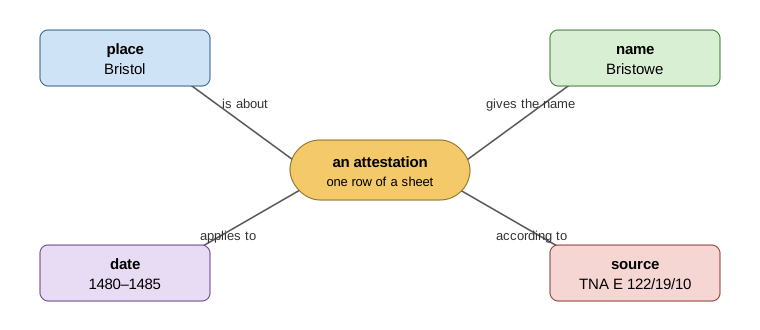
One attestation: this source, for these dates, gives this name for this place.
An attestation is a single piece of evidence: this source says that this place had this name at this time. Another source might give Bristoll in 1540, and a gazetteer might give modern coordinates. Each of those is another attestation about the same place. None of them overwrites the others.
Places
The thing the attestations are about is, most of the time, what anyone would call a place: a town, a parish, a river, a region. PLATO’s own word for it is SpatialEntity, because not everything a gazetteer records is what everyone would call a place (a road, a trade route, the region a historical period applies to), and because “place” means rather different things in different languages and disciplines. PLATO does not give the word “place” any special meaning of its own.
In the spreadsheets the first sheet is called places, because that is what most people expect. Each row in it becomes a SpatialEntity.
A place in PLATO has very little of its own: an identifier and a label to list it under. Its names, locations and types all come from attestations, because all of them can change over time and all of them depend on a source.
Sources and where in them
Every attestation names its source: a document, a map, a book, a dataset. You list each source once, in the sources sheet, and refer to it from as many rows as you need.
If you want to say where in the source the evidence is, such as a page, a folio or an entry number, that goes in the row’s locator, not in the source. One book cited at twenty different pages is still one source.
A source can also be a copy of another. A charter known only from a later cartulary is two sources, each with its own date, one derived from the other. Your attestation cites the one you actually read.
Dates
Every attestation has a date: the date the statement applies to, written as the source gives it (“1086”, “c. 925”, “1480–1485”, “a. 1300”), or “undated”. If you can, you also give the earliest and latest years it could mean, in from and to. That way the original wording is kept and computers can still sort and compare.
The date of the statement is not the same as the date of the source. An annal for the year 921 read in a manuscript written around 925 is dated 921; the manuscript’s own date, c. 925, belongs to the source.
How sure, and what kind of evidence
You can say how certain you are of a row, from 0 (not at all) to 1 (certain). That is about the evidence: better evidence could change it.
Some evidence is certain but of a weaker kind. A place-name found only inside a person’s name (Willelmus de Bonestou) proves the name existed, but not that anyone was using it for the place. PLATO lets you mark such cases rather than lowering your certainty, so that the reason is kept.
Why this way
Because every statement keeps its source and date, datasets from different projects can be combined without anyone’s evidence being flattened into someone else’s. A user can always ask who says so, and when? And because a place’s names and locations are evidence rather than fixed properties, disagreements between sources can be recorded instead of resolved by deletion.