Working groups represent the core business of Pelagios. Each working group generally meets every other month, to address issues and challenges related to the core area of interest. Meetings focus on:
Pelagios working groups are based on two dimensions of LOD practice: (i) core entities of Place, People, and Time; and (ii) core processes of Annotation, Registry, and Visualisation. The primary goal of each working group is to work towards consensus and standards for the common representation of historical entities in structured LOD.
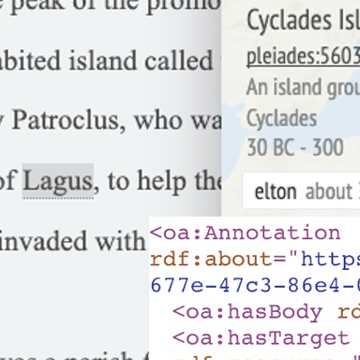
The Annotation Working Group promotes the use of W3C web annotation for enriching resources (both text and image) describing historical phenomena and linking them according to FAIR data standards. We focus on sharing knowledge about different tools for semantic enrichment and establishing pipelines between different media and tools. We are also interested in documenting different typologies for categorising named entities (places, people, time periods). Email us
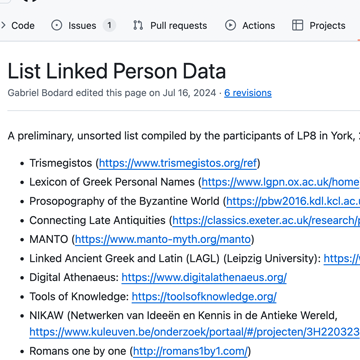
The People Working Group surveys practice in and collects guidance for linking historical person datasets. Consulting widely with communities of practice and stakeholders, we recommend lightweight, minimal standards for interchange data, compatible with Pelagios registries, APIs and annotation tools. Results and discussions are disseminated openly throughout via online platforms, forums and repositories. Email us
The Place Working Group brings together scholars and practitioners working on the conceptual and technical challenges of representing place in digital humanities research. We focus on aligning and interpreting place references across heterogeneous historical datasets while treating place as relational, temporal, and contested. The group supports shared methods and conversations that move beyond fixed coordinates toward historically grounded place-based knowledge. Email us
The Registry Working Group catalogues and documents existing LOD knowledge graphs (KGs) for places and other entities. By contributing to the creation of an open catalogue of KGs, we aim to enhance the visibility and discoverability of existing KGs. We also gather or create documentation about the catalogued KGs in the format of pairs of (natural language) questions and their corresponding SPARQL queries. Email us
The Time Working Group facilitates discussion of temporal reference systems for historical time, including non-Gregorian calendars, chronometric scales, and ordinal systems such as named periods. By exploring the modelling of sequences of past, rather than historical, events, we encompass both archaeological situations and textual evidence. We are also interested in vague, uncertain or incomplete temporal references, as well as reasoning about possible temporal orderings of events.
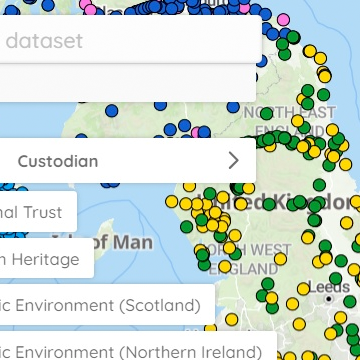
The Visualisation Working Group advocates for semantic annotation and LOD as means for discovering, utilising and repurposing historical and cultural documents. In particular, we support researchers and cultural heritage professionals in using and adapting the Peripleo webmap for visualising place-based collections across a range of different periods and geographic regions. We also promote dialogue within the data visualisation community more broadly. Email us